


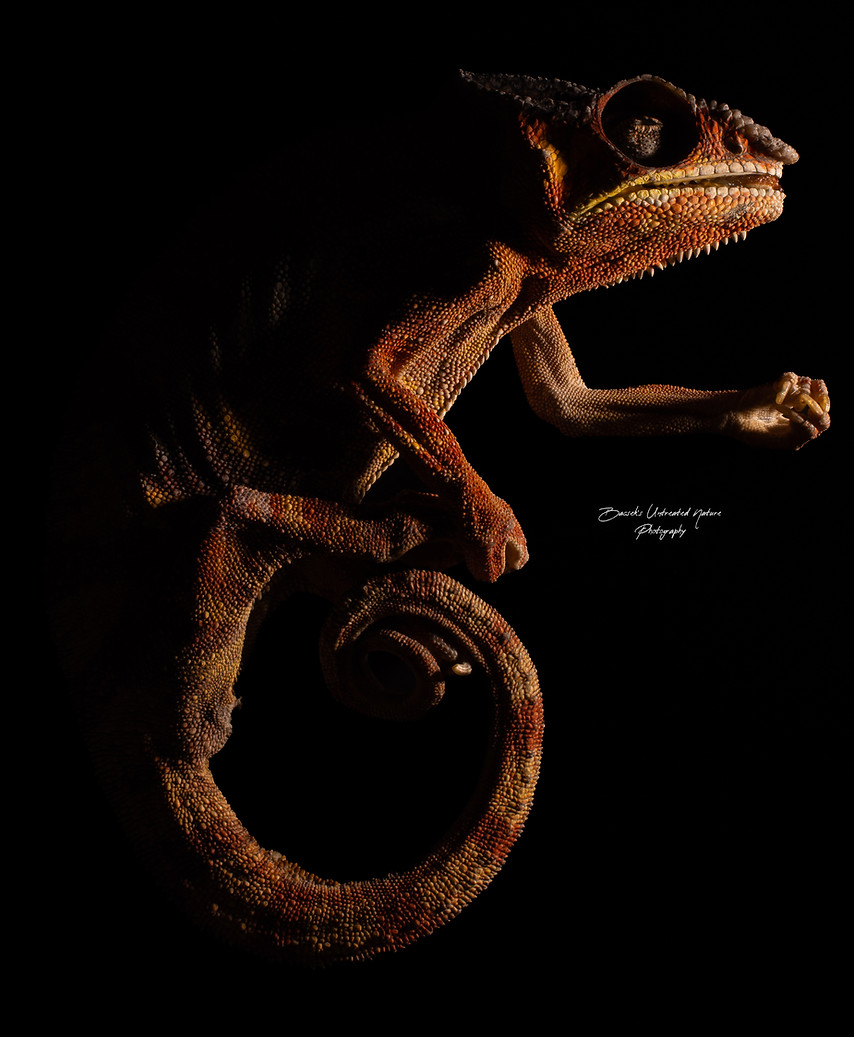
Although the Panther Chameleon does not possess a direct fossil lineage, molecular phylogenetic analyses place its evolutionary emergence squarely within Madagascar.
The broader chameleon family, Chamaeleonidae, is believed to have diverged from other squamate reptiles approximately 90–100 million years ago.
Fossil evidence for chameleons begins in the Miocene (~18–20 million years ago), though these remains are sparse. Madagascar serves as a critical center for chameleon diversification, with the genus Furcifer including F. pardalis, being entirely endemic to the island.
The Panther Chameleon likely evolved within the island’s lush northeastern and eastern rainforests, adapting to highly localised climatic and ecological conditions.

Furcifer pardalis is a fully arboreal species, spending its life navigating the canopies of Madagascar’s humid lowland forests. Its range extends primarily along the eastern coast but also includes introduced populations on nearby islands such as Réunion and Mauritius.
These chameleons are solitary and strongly territorial, using dynamic color changes to communicate with conspecifics.
Aggression, stress, courtship, and thermoregulatory needs are all mediated through specialized skin pigmentation. Their hunting behavior is based on ambush predation, relying on an explosive, elastic tongue to capture fast-moving insect prey.
Panther chameleons
don’t just change color for camouflage. They do it to express emotions, assert dominance, attract mates, and regulate body temperature. Their skin acts like a living display board of their inner state.
Color expression is a direct physiological indicator of behavioral state: calm individuals remain muted, while excited or stressed chameleons display intense, rapidly shifting patterns.
Panther chameleons glow blue under UV light because their bone tubercles, especially on their heads and crests, are naturally fluorescent. The skin covering these tubercles is thin and transparent, acting as a window that allows UV light to reach the bone. The bone then absorbs the UV light and re-emits it as blue fluorescent light.
_JPG.jpg)
Males can see UV light, which plays a role in communication and mate attraction. Colors may look even more dramatic in their world than ours.