

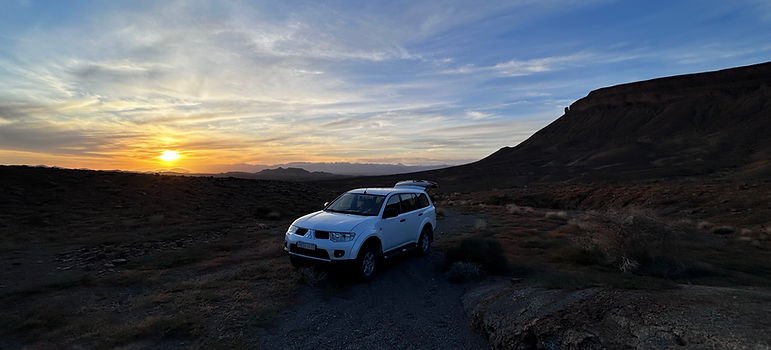
.jpg)
Journey Through Pray
and Science in Morocco!
Part.1
When someone mentions Morocco, we tend to think of the desert, the medinas, camel rides, the astonishing Atlas Mountains, the unique culture of the Berbers, and the hidden treasures of the country. However, my travels to North Africa’s lesser-known regions called me for another reason. For me, it all started with a search for the next best place to continue building my hypothesis on how certain biomaterials in fossiliferous geological formations influence microbial behaviour in the soil and, affect the structure and development of arid zone plants. Thanks to 21st-century technological advancements, I began searching for the right people who could help to bring me closer to my answers. Little did I know that my research would lead me deep into the world of North Africa’s fossil trade, thanks to “Ben” and his family. In 1916, the French geologist Louis Gentil discovered a trilobite fossil near Casablanca, marking one of the earliest documented finds in Morocco.
Throughout the 20th century, local nomads began excavating fossils to sell to tourists, collectors, and scientists as a means of providing for their families. However It didn’t take long for fossil hunting to evolve thanks to local expertise into the fossil industry we know today. By the year 2000, fossil trading had become a substantial economic sector, with more than 50,000 Moroccans earning their living through excavation, trade, or export. The industry’s annual value had reached an estimated $40 million.
.jpg)

When I began searching for connections in Morocco, I knew I needed someone with experience in fossil hunting someone, who could take me to places where I could collect crystallised specimens for my experiments. Through social media, I met “Ben” and All I knew about him was that he is a fossil hunter and trader based in a small town near Alnif, where he owned a shop and was open to working with me.
Since I’m neither a
palaeontologist nor a professional fossil hunter, I asked for guidance from Sandor Krizsan, a mammoth specialist, researcher, and fossil hunter from Hungary, before setting off on my journey.
I arrived in the Alnif region at the Tinghir bus station, where I met my contact, Ben, for the first time. From the very beginning, he introduced me to his culture through his warm, friendly, and open-minded approach to both me and my research. We had a 1.5-hour drive ahead of us, during which he shared with me the rich heritage of the indigenous Berber or Amazigh people, whose name means “free people” in Tamazight. They have lived in this region for thousands of years, long before the arrival of the Arabs, Romans, and other civilisations.
Before adopting Islam, the Amazigh people practiced animism, believing in natural spirits that inhabited rivers, mountains, soil, trees, animals, and fire. They worshiped ancestral spirits and practiced shamanistic rituals, with falcons, lions, and snakes being considered as sacred animals. Historically, they regarded fossils as curious objects, even supernatural stones, using them as talismans, medicine, jewellery, or for religious purposes. Today, fossilrelated activities remain one of the few employment options in the region, leading many to refer to the local economy as the “trilobite economy.”
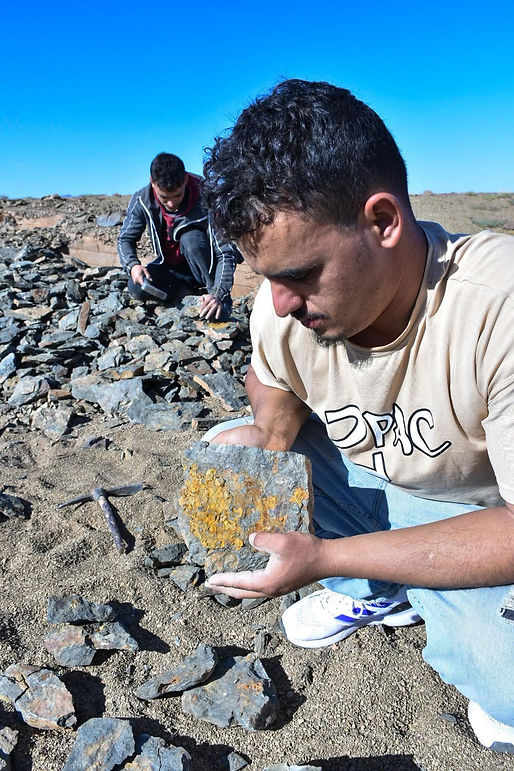%20(1).jpg)
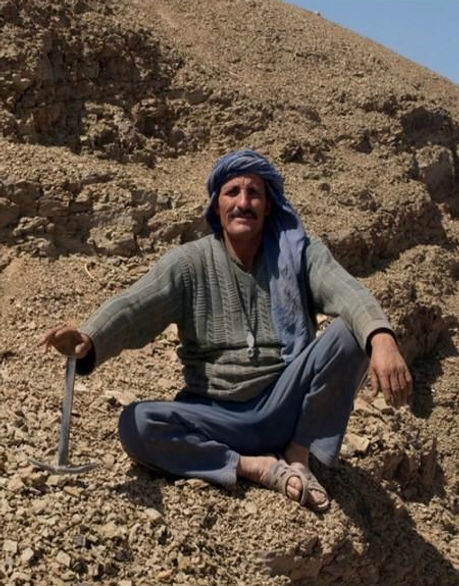
At sunrise the next day, Ben invited me to his home and shop, where he shared stories about his family’s deep-rooted connection to fossil hunting. His father, Mohamed Ben Moula, was born in 1952 into a nomadic farming family. At the age of six, he met a geologist looking for fossils near Alnif and when the geologist’s search proved unsuccessful, Mohamed showed him a fully preserved trilobite and was paid handsomely for it. Realising the opportunity before him, Mohamed devoted his life to searching for fossilised “treasures.”
Between 2000 and 2005, while on one of his fossil-hunting expeditions, Mohamed made a remarkable discovery what in 2015, palaeontologists Peter Van Roy, Allison C. Daley, and Derek E.G. Briggs formally described his find as a giant sea creature that lived 480 million years ago during the Paleozoic Era, preserved in the Fezouata Shale deposits of southeastern Morocco. Not long after Mohammed found This unusual arthropod, the researchers named
Aegirocassis benmoulae in honour of Mohammed’s work in paleontology. Aegirocassis Benmoulae used large flaps instead of fins to swim while filtering planktons from the water. It was identified as not only one of the largest animals of its time but also the largest arthropod ever discovered from that period. Mohamed’s contributions to palaontology did not end there, he remained a key figure in numerous excavations, helping uncover dinosaur fossils, as well as various marine and terrestrial specimens. Beyond his discoveries, he was dedicated to educating his community and the public about Morocco’s rich prehistoric biodiversity and his devotion to paleontology and science, which is why in 2017 The Paleontology Association rewarded him with the Mary Anning award.
You can read the Article here.