


“Adaptation knows no compassion;
when survival demands it,
even life itself bends and turns Monstrous.”
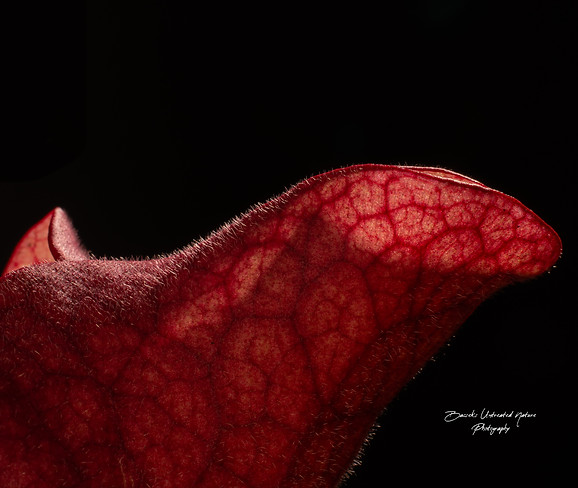
Sarracenia Purpurea (Purple Pitcher Plant)
Private Collection

At first, the idea seemed absurd;
A gentle, sun-loving plants could move and kill, really?
Yet that chilling realisation not only inspired of horror stories but also triggered the curiosity of generations of Naturalists. Among them was Charles Darwin himself, who devoted 16 years to a series of experiments that would uncover the hidden truth about these plants, that they had evolved into silent “assassins”, armed with leaves transformed into deadly traps, capable of both digesting and absorbing the corpses of their prey.
Thanks to today’s technological achievements, researchers are getting closer every day to solving one of botany’s greatest riddles.
In the wild, carnivorous plants thrive in the most inhospitable places, such as acidic bogs, barren swamps, nutrient-starved soils, and in environments where traditional survival strategies are failing.
Approximately 140 million years ago, in this habitat where innovation was born from necessity, insects became the perfect choice since they are rich in nitrogen and phosphorus, making them the most suitable alternative meal. A single large catch can fuel a pitcher plant for weeks, pushing it to grow even more elaborate pitchers to help secure the chances for the next catch.
Sarracenia purpurea
The Purple Pitcher plant, is one of the oldest and most widespread species in the Sarracenia genus. However, It’s evolutionary roots trace back to the Eocene (~35–40 million years ago) when early carnivorous plants adapted to the acidic, nutrients poor wetlands of ancient North America. Unlike it’s more southern relatives, Sarracenia Purpurea adapted to colder, temperate environments. As glacial cycles shaped the continent, S. Purpurea spread northward, becoming the only pitcher plant to colonise boreal and subarctic regions.
No matter how diverse or bizarre their killing techniques, all these botanical predators share a common secret:
Every trap is a leaf, modified to perfection.
Their victims are lured in by sweet nectars,
hypnotic colours, and deceptive scents
for only to find themselves captured in waxy, inescapable chambers where digestion begins.

The weapons they wield, not new at all.
Decades ago, scientists discovered that the very enzymes dissolving unlucky insects were once used by plants for defence!
Chitinases once used for to shred fungal walls, Proteases to dismantle invading proteins, and Purple Acid Phosphatases to scavenge precious nutrients. Over time, evolution repurposed these biological defences into tools for a darker, more direct survival strategy. Now, devouring the very creatures plants had once merely fought to repel.
With a genome sequencing technology, researchers have started to decoding the molecular playbook behind these living death traps. They’re finding not just familiar enzymes, but a brilliant arsenal of new ones which hints that plants have been experimenting with carnivory far longer, and far more creatively, than anyone ever imagined.
The Native American people, used this species in treating smallpox by means of a root infusion. A 2012 study suggests *Sarracenia purpurea* is effective as a treatment for viruses in the Orthopoxvirus family, including the smallpox virus, through inhibition of early virus transcription.
Sarracenia purpurea, with its striking, deep-purple pitchers and elegant, ground-hugging rosettes, is a favorite among ornamental plants. Its bold color, unusual form, and year-round hardiness make it a living sculpture for gardens, terrariums, and water features. Beyond it's beauty, it also naturally controls insect pests, adding both visual drama and practical value to any space.
But one question still emerge more unsettling than ever:
If plants could evolve into predators once… could they do it again, or what’s next ?